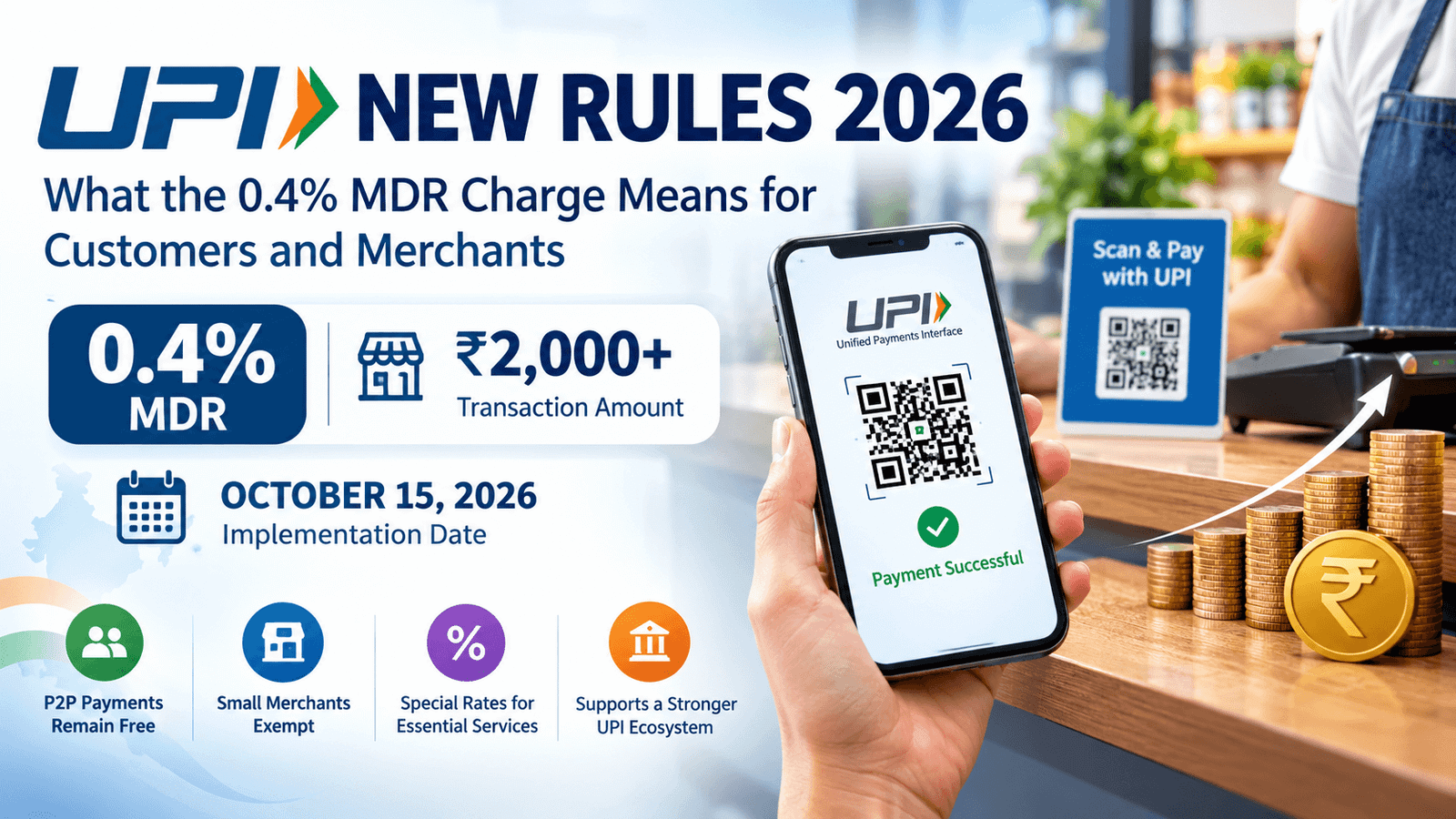
UPI new rules 2026 are set to change how certain merchant payments are handled in India from October 15, 2026. Under the new Merchant Discount Rate (MDR) framework, a 0.4% MDR will apply to specified person-to-merchant UPI transactions above ₹2,000.
The change has raised questions among shoppers, small businesses, retailers and other UPI users about whether they will have to pay extra when making digital payments.
The important point is that the MDR is a charge within the merchant payment ecosystem. According to the government, customers are not supposed to be directly charged the MDR.
What Are the New UPI Rules in 2026?
Under the new framework, a 0.4% Merchant Discount Rate will apply to specified UPI payments made to merchants when the transaction amount is above ₹2,000.
The new framework is scheduled to take effect from October 15, 2026.
Person-to-person UPI payments remain outside the MDR framework, regardless of the amount transferred.
Will Customers Have to Pay UPI Charges?
For ordinary consumers, the answer is generally no under the announced framework.
The government has stated that the MDR is not a customer fee and that consumers will continue to use UPI without directly paying the MDR. Person-to-person transactions also remain free.
However, customers should still check the payment amount and merchant's billing information. Businesses may separately communicate their own payment policies, but the announced MDR itself is a merchant-side charge.
What Is the 0.4% UPI MDR Charge?
MDR stands for Merchant Discount Rate. It is a fee associated with accepting certain digital payments and is distributed among participants in the payment ecosystem.
For specified UPI merchant transactions above ₹2,000, the standard MDR under the new framework is 0.4%.
For transactions of ₹75,000 or more, the MDR is capped at ₹300 per transaction.
UPI Charge Examples
| Merchant Payment | 0.4% MDR | Maximum Applied MDR |
|---|---|---|
| ₹2,001 | ₹8.00 approximately | ₹8.00 approximately |
| ₹5,000 | ₹20 | ₹20 |
| ₹10,000 | ₹40 | ₹40 |
| ₹50,000 | ₹200 | ₹200 |
| ₹75,000 | ₹300 | ₹300 |
| ₹1,00,000 | ₹400 | ₹300 cap |
These examples illustrate the MDR calculation. The actual amount applicable to a transaction depends on the merchant category and the rules covering that payment.
What Happens to UPI Payments Below ₹2,000?
Merchant UPI payments up to ₹2,000 remain outside the standard 0.4% MDR framework.
This means a customer paying a shop ₹500, ₹1,000 or ₹2,000 through an eligible UPI merchant transaction will not face the new 0.4% MDR under this framework.
Person-to-person UPI transfers also remain free.
Are Small Merchants Exempt?
Yes, certain small merchants covered by the zero-MDR framework remain exempt.
The government has stated that transactions covered under the small-merchant framework will remain free. It estimates that approximately 96% of P2M UPI transactions will remain unaffected by the new MDR.
This is particularly relevant for small retailers and businesses that receive relatively low monthly UPI payments.
Special UPI Rates for Essential Services
The new framework also provides different treatment for certain essential and thin-margin sectors.
For specified sectors such as:
- Railways
- Telecommunications
- Insurance
- Fuel
- Agricultural inputs
transactions above ₹2,000 are subject to a flat MDR of ₹5 per transaction under the announced framework.
What About Mutual Funds and Stock Market Payments?
Specified capital-market transactions have a lower MDR rate under the new framework.
Payments related to areas such as mutual funds, securities, stockbrokers and dealers are subject to an MDR of 0.02%, with a maximum cap of ₹300 per transaction.
Why Is UPI Introducing MDR?
UPI has operated for years with a zero-MDR model for many ordinary transactions. The new framework is intended to create a revenue mechanism for the payment ecosystem while continuing to keep most everyday UPI transactions free.
The government says the framework is designed to support the long-term sustainability and continued expansion of the UPI ecosystem.
UPI has become a major part of India's digital payment system, making the way merchant payments are funded an important issue for banks, payment companies and businesses.
Supreme Court Decision on UPI MDR
The UPI MDR framework also became the subject of a legal challenge.
On September 28, 2026, the Supreme Court declined to grant an interim stay on the implementation of the new MDR framework. The court sought responses from the Centre and other parties involved in the case.
The MDR framework is therefore scheduled to proceed from October 15 unless there is a subsequent change through legal, regulatory or government action.
What Does This Mean for Small Businesses?
Businesses that accept UPI payments should review their payment arrangements before the new framework takes effect.
Merchants may want to:
- Check which UPI transactions fall under MDR.
- Confirm their merchant category with their payment provider.
- Review monthly UPI transaction volumes.
- Understand whether their business qualifies for an exemption.
- Check how their bank or payment service provider will settle the MDR.
- Keep customers informed about payment options.
Businesses should not assume that every UPI transaction will automatically attract the 0.4% rate because exemptions and special categories apply.
Will UPI Still Be Free for Person-to-Person Payments?
Yes. Under the announced framework, person-to-person UPI payments remain free regardless of the amount transferred.
For example, if you send ₹5,000 to a family member or friend through a person-to-person UPI transfer, the new merchant MDR does not apply.
Will PhonePe, Google Pay and Other UPI Apps Charge Customers?
The new MDR is not a general consumer fee for using a UPI application.
The framework applies to specified merchant transactions and operates within the payment ecosystem. Consumers should therefore distinguish between a merchant-side MDR and any separate service fee that an individual payment application might introduce under its own terms.
Always check the payment screen and the terms of the service you are using before completing a transaction.
What Should UPI Users Do Now?
For most consumers, there is no need to change how they use UPI immediately.
However, it is useful to understand the difference between:
- Person-to-person payments: Remain free.
- Merchant payments up to ₹2,000: Remain outside the standard MDR.
- Specified merchant payments above ₹2,000: Subject to the new MDR framework.
- Small merchants covered by exemptions: Continue under the applicable zero-MDR framework.
UPI New Rules 2026: Quick Summary
| Rule | What It Means |
|---|---|
| Effective date | October 15, 2026 |
| Standard MDR | 0.4% on specified merchant payments above ₹2,000 |
| Transactions up to ₹2,000 | Remain outside the standard MDR |
| Person-to-person payments | Remain free |
| ₹75,000 and above | MDR capped at ₹300 |
| Specified essential sectors | ₹5 flat MDR above ₹2,000 |
| Specified capital-market payments | 0.02% MDR, capped at ₹300 |
Frequently Asked Questions
When will the new UPI MDR rules start?
The new UPI MDR framework is scheduled to take effect on October 15, 2026.
Will customers pay 0.4% when using UPI?
The announced MDR is a merchant-side charge within the payment ecosystem, not a direct fee that customers are required to pay for using UPI.
Are UPI payments below ₹2,000 still free?
Specified merchant payments up to ₹2,000 remain outside the standard MDR framework. Person-to-person transactions also remain free.
What is the maximum MDR for large UPI merchant payments?
For specified transactions of ₹75,000 and above, the MDR is capped at ₹300 per transaction.
Does the new MDR apply to sending money to another person?
No. Person-to-person UPI transactions remain outside the MDR framework.
Will every merchant have to pay the 0.4% MDR?
No. The framework includes exemptions and special rates for certain merchant categories and small merchants.
Final Takeaway
UPI new rules 2026 introduce a new MDR framework for specified merchant transactions above ₹2,000 from October 15. The standard rate is 0.4%, with a ₹300 cap for transactions of ₹75,000 and above.
For ordinary UPI users, the key point is that person-to-person payments remain free and merchant payments up to ₹2,000 remain outside the standard MDR. The government also says approximately 96% of P2M UPI transactions will remain unaffected.
Businesses that accept UPI should review their merchant category and payment arrangements before the October 15 implementation date.
Sources
- Government of India – Ministry of Finance
- Department of Financial Services – UPI MDR FAQs
- Press Information Bureau – UPI MDR framework
- Supreme Court-related reporting from The Indian Express
- Reuters – UPI fee framework and payment ecosystem
Disclaimer: This article is for general informational purposes only. UPI rules and implementation details can change. Businesses and consumers should check the latest information from the government, NPCI, banks and payment service providers before making decisions.